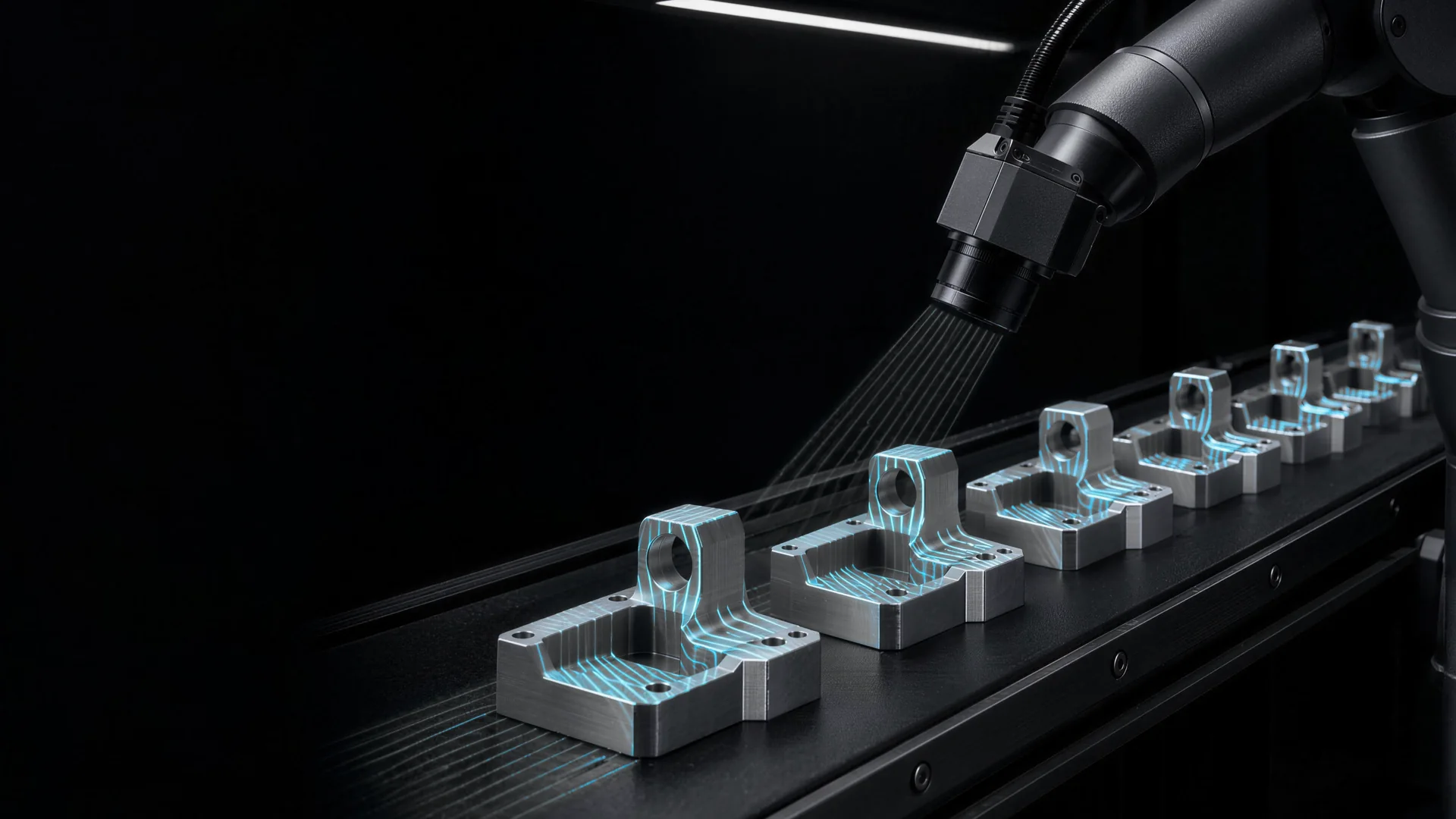
Promeing ConceptScenario set in Nürnberg
Autonomous Vision System
IndustryIndustrial inspection and robotics
Visualisation
- Status
- Promeing Concept
- Scenario
- Nürnberg
- Industry
- Industrial inspection and robotics
- Sheet
- 04 / 06
A vision-guided inspection and pick cell for mixed parts, designed and tested in simulation before any hardware is committed.
A Promeing Concept: a studio study of a system we would build, set in a realistic scenario. It describes no client, no deployment and no measured result.
Problem
Mixed parts arrive on a line in no fixed order and orientation. Manual inspection is slow and tiring, fixed automation only handles the parts it was built for, and buying a robot cell before knowing whether it can see and grasp the real parts is an expensive way to find out.
Context
The scenario: a supplier of machined and cast parts in Bavaria, running short batches of many part types on shared lines. Surface defects matter, lighting varies across the hall, and the parts change faster than a fixed inspection rig can be re-taught. The decision to invest in a cell has to rest on evidence about this line, not on a vendor demo.
System
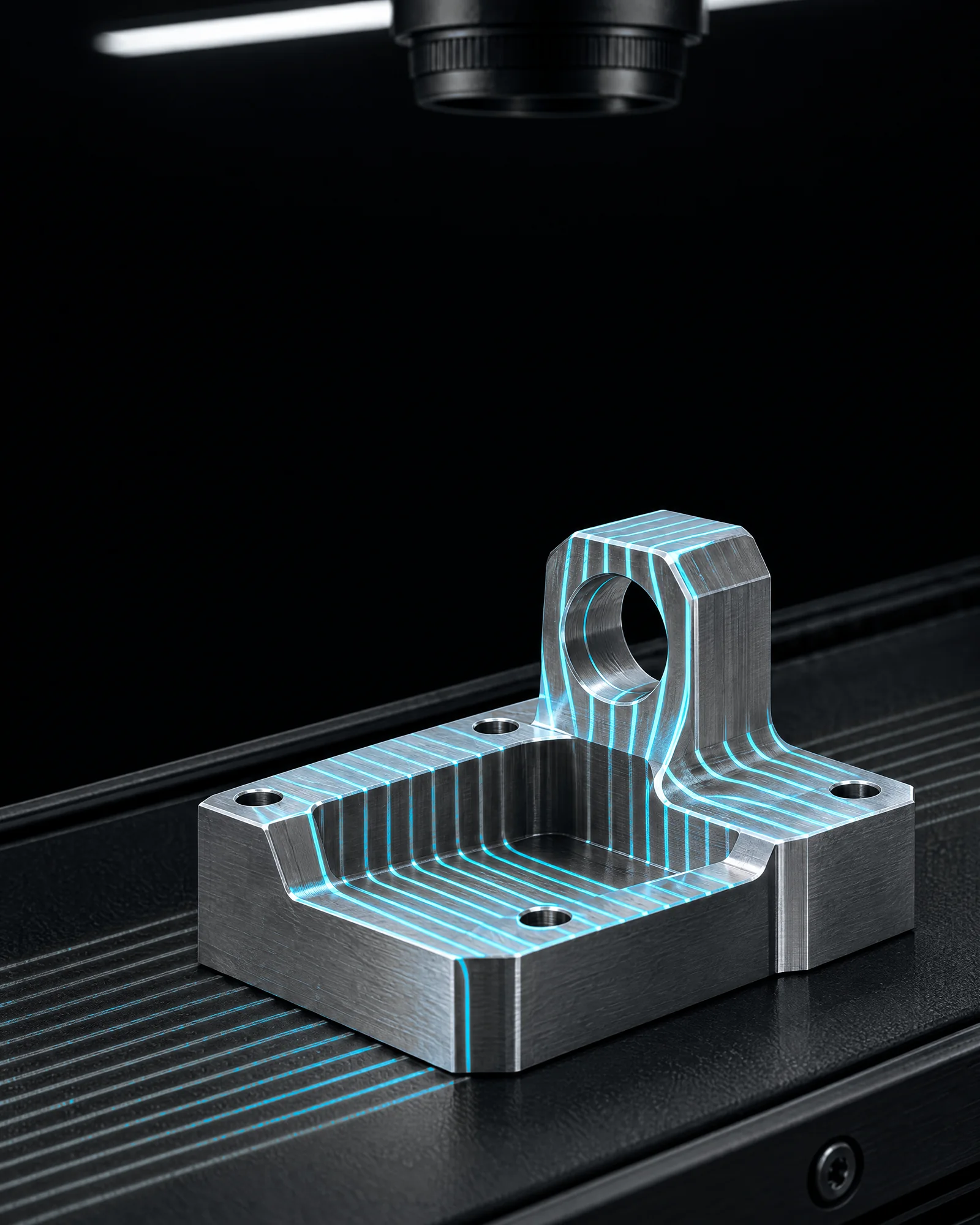
A cell design developed and validated in simulation first. Synthetic and real images train a detector that finds, segments and tracks each part on the moving line, keeping its ID as parts pass and overlap. A grasp planner chooses where and how the arm should pick, within the cell’s reach and cycle constraints. Parts with uncertain classification or a suspected surface defect are never guessed at: they are routed to a person, with the image and the reason. The same software runs against the simulated cell and, later, the physical one, so the evaluation carries over.
AI architecture
Cameras feed detection and tracking; a grasp planner turns tracks into motion for the arm. A simulation of the cell sits beside the real one, and everything uncertain goes to a review queue.
AI architecture of Autonomous Vision System
Layers
- Interface: Operator console, Review queue
- Agents: Grasp planner, Cell controller
- Models: Detection and segmentation, Multi-object tracker
- Data: Synthetic and real image sets
- Infrastructure: Cell simulation, Edge compute at the line
Connections
- Edge compute at the line → Detection and segmentation
- Synthetic and real image sets → Detection and segmentation
- Detection and segmentation → Multi-object tracker
- Multi-object tracker → Grasp planner
- Grasp planner → Cell controller
- Multi-object tracker → Review queue
- Cell controller → Operator console
- Cell simulation → Cell controller
Interface
The operator view of a simulated run: what the camera sees, the tracks it keeps, the grasp it plans, and the parts it sends to a person instead of guessing.
| T-118 | bracket | Picked |
| T-119 | bracket | Grasp planned |
| T-120 | bracket | Sent to review |
| T-121 | housing | Passing |
- Target
- T-119
- Approach
- From above, tilted
- Joint targets
- —
T-120 · suspected surface defect · image attached
- A: Detection and tracking: each part keeps its ID as it travels and overlaps.
- B: The grasp plan for the part the cell is attending to, within reach and cycle constraints.
- C: Uncertain or suspect parts go to a person with the image and the reason.
Numerals appear only in dates, IDs and timestamps. Indicators read — until there is something true to show.
Technology
- Instance segmentation and multi-object tracking
- Synthetic training data from CAD models, with domain randomisation
- Physics simulation of the cell before hardware is bought
- Grasp planning within reach and cycle-time constraints
- Edge inference on industrial compute at the line
- Structured lighting and camera placement studied in simulation
- Robot integration through the vendor’s controller interface
Expected outcome
ExpectedA cell design validated in simulation before a physical pilot, an honest view of which parts it can and cannot handle, and an investment decision made on evidence.
Qualitative and unmeasured. A pilot measures it against acceptance criteria agreed at the start.
What we would measure
- Precision and recall on held-out real footage
- False-alarm rate for surface defects
- Performance by lighting condition
- Grasp success in simulation and on the physical cell
- Parts routed to a person, and why
Metric names only. Values exist once a pilot measures them.
What a pilot would need
- CAD models or reference scans of the parts in scope
- Recorded footage from the line, in the hall’s real lighting
- Examples of the defects that matter, labelled by an inspector
- The cell’s constraints: space, cycle time, safety zones
- A shortlist of candidate arms and grippers to simulate
- An inspector to review every routed part during the pilot
Promeing ConceptScenario set in Nürnberg
Building something like this?
Bring the problem in its messiest form. We’ll tell you honestly whether AI is the right way to solve it.